
Why Old Durban Buildings Outlast Modern Ones
Durban’s Architectural Divide: Built to Last vs Built Fast
Walk through Durban and you can almost feel time layering itself into the walls. In the city centre, older buildings stand like stubborn veterans: sun-faded, salt-weathered, but still upright and functional. A few streets away, newer developments sometimes show early signs of fatigue, from cracking plaster to water ingress and façade deterioration.
This contrast is not coincidence. It is the result of shifting construction philosophies across decades, where materials, labour practices, and economic pressures have reshaped how buildings are made in the coastal environment of Durban.
Durban’s climate plays its own role in the story. High humidity, salty air, and seasonal rainfall create a persistent stress test for any structure. Buildings here are not just built, they are continuously tested by the ocean breeze itself.
The Older Stock: When Buildings Were Built Like Institutions
Many of Durban’s older buildings, particularly those from the late 19th and early 20th centuries, were constructed during a period when permanence was the default expectation rather than an optional upgrade.
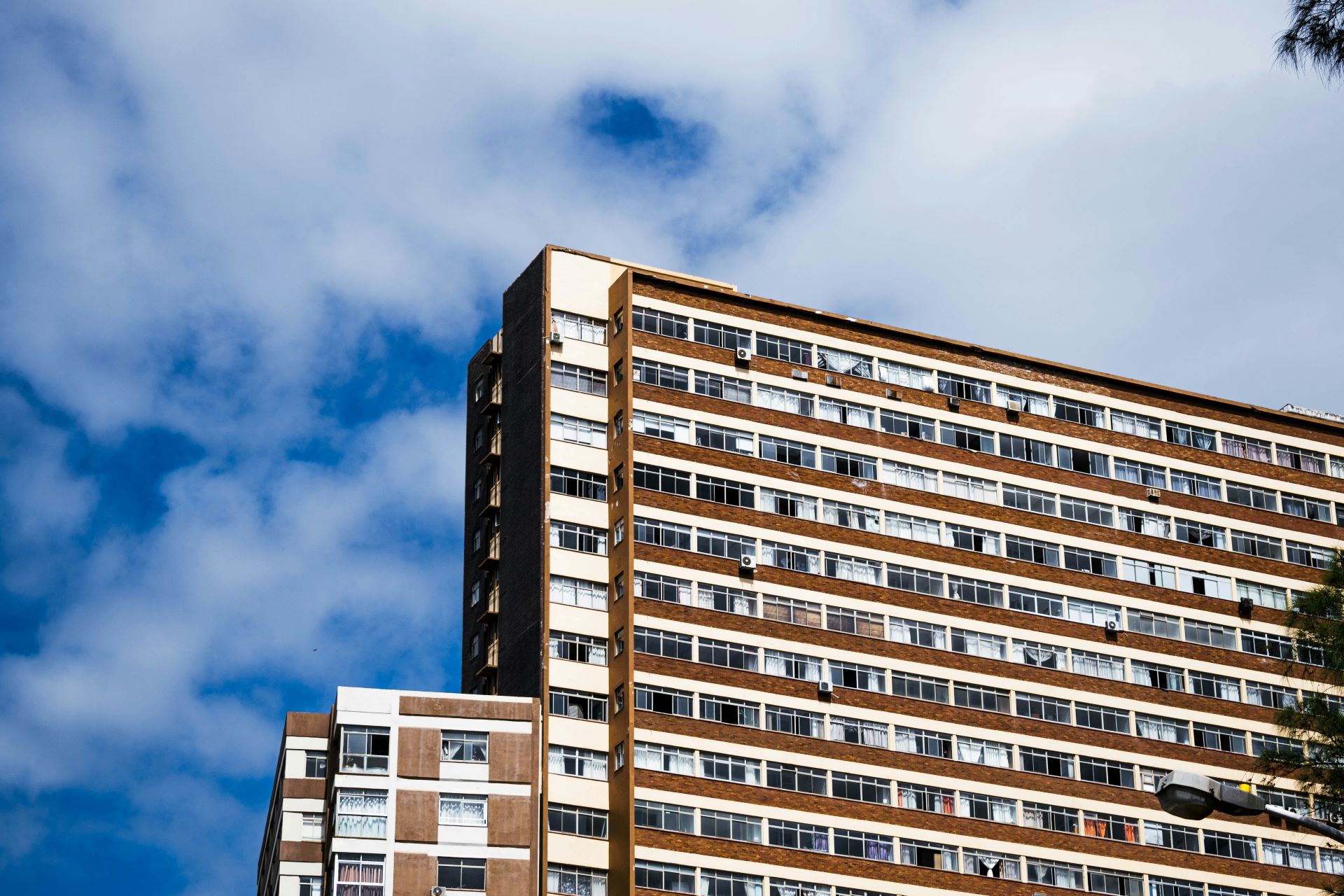
Victorian and early colonial-era structures often used dense fired clay brick, lime-based mortars, and thick load-bearing walls. These materials were not chosen for speed or cost efficiency, but for durability and availability under constrained logistics. A building like the historic Durban railway station, completed in the 1890s, reflects this approach with its strong brick massing and robust detailing that still holds up today under continuous urban use. :contentReference[oaicite:0]{index=0}
Even decorative elements served structural purposes. Deep verandas, heavy cornices, and shaded façades were not just aesthetic flourishes but environmental responses, reducing heat load and protecting walls from direct rain exposure.
Craftsmanship was central. Builders were often trained artisans working with slow-setting materials. Mortar curing times were respected, and structural components were over-engineered by modern standards. The result is buildings that may look ornate or “old fashioned,” but which possess a quiet structural confidence.
Materials That Age Slowly, Not Quickly
One of the defining reasons older Durban buildings survive is material selection.
Traditional clay brick, especially when well-fired, performs exceptionally in coastal environments. It resists salt penetration better than many modern lightweight wall systems. Lime mortar, used widely before modern cement dominance, is more flexible, allowing buildings to “breathe” and accommodate minor movement without cracking.
Compare this with many modern constructions that rely heavily on Portland cement, hollow concrete blocks, and thin plaster systems. While strong in compression, these materials can be less forgiving when exposed to thermal expansion, moisture cycling, and long-term coastal corrosion.
Durban’s humidity accelerates this difference. Moisture trapped behind modern sealed finishes often leads to hidden degradation, while older buildings tend to manage moisture more naturally through permeability.
Even roofing systems tell a story. Older timber roof trusses, when properly maintained and protected, often outlast newer lightweight steel systems that are more vulnerable to corrosion if protective coatings fail.
The Craftsmanship Gap: Skill vs Speed
Construction quality is not only about materials. It is also about hands.
Older Durban buildings were typically constructed under slower project timelines. This allowed for careful masonry work, proper curing, and iterative quality checks that were embedded into the process rather than rushed at the end.
Modern construction, especially in fast-growing urban areas, is often driven by compressed schedules. Labour is frequently subcontracted in layers, which can dilute accountability and reduce continuity of workmanship across phases of a project.
This does not mean modern builders lack skill. Rather, the system often prioritises delivery speed and cost control over artisanal precision. The result is that small deviations, like slightly uneven plastering or insufficient waterproofing attention, can accumulate into long-term maintenance issues.
Older buildings, by contrast, were often constructed by teams who remained on the same project from foundation to completion. That continuity creates consistency in execution that is difficult to replicate today.
Durban’s Coastal Climate: The Silent Stress Test
Durban is one of South Africa’s most demanding environments for buildings.
Salt-laden air accelerates steel corrosion. High rainfall introduces constant moisture cycles. Heat and humidity expand and contract materials daily. Together, these forces create a long-term durability challenge that punishes weak detailing.
Older buildings often survive this better because they were designed with larger safety margins. Thick walls slow moisture penetration. Deep roof overhangs reduce direct rain exposure. Elevated foundations and ventilated substructures allow airflow that prevents trapped dampness.
In contrast, many modern buildings rely on tighter envelopes and sealed systems. While these can improve energy efficiency, they require flawless waterproofing and ventilation design. When any small failure occurs, such as a membrane breach or sealant degradation, moisture tends to accumulate unseen.
Once moisture enters modern layered wall systems, repair becomes complex and expensive. Older solid-wall structures, by comparison, often “show” their problems externally before they become structurally severe.
Maintenance Culture: Designed In vs Managed Later
A major difference between older and newer buildings lies in how maintenance was anticipated.
Older construction implicitly assumed maintenance would happen. Buildings were designed to be accessible, repairable, and adaptable. Plaster could be patched. Timber elements could be replaced. Brickwork could be repointed without dismantling entire systems.
Modern buildings are often designed as integrated systems. External façades may involve composite cladding, insulation layers, waterproof membranes, and sealed finishes. These systems perform well when intact, but they are less modular when problems arise.
In Durban, where moisture intrusion is a constant risk, this creates a maintenance paradox. The more “advanced” the building envelope, the more dependent it becomes on perfect installation and consistent upkeep.
Where maintenance budgets are constrained, deterioration in modern buildings can appear faster, even if the underlying structural design is technically advanced.
Case Patterns Across Durban’s Built Environment
Across Durban’s older central districts, many heritage buildings still function as offices, civic spaces, or residential conversions. Their continued survival is often due to robust original construction combined with adaptive reuse.
Some have been carefully restored, while others have endured through continuous occupation and incremental repairs. Even when worn, their structural cores remain resilient.
Meanwhile, newer developments sometimes show early lifecycle issues within decades rather than generations. Common patterns include façade cracking, waterproofing failures, and corrosion in reinforced concrete elements exposed to coastal air.
This does not imply universal failure of modern construction. Instead, it highlights variability in execution quality and the sensitivity of modern systems to installation precision.
Economics: The Invisible Force Behind Construction Quality
Construction quality is never purely technical. It is deeply economic.
Older buildings were expensive in labour terms but economical in material simplicity. Skilled labour dominated the cost structure, encouraging careful execution.
Modern construction often flips this equation. Labour is cheaper and more fragmented, while materials and systems are more complex. This encourages efficiency-driven decision-making, where time savings can outweigh long-term durability considerations.
In fast-developing urban areas like Durban, this dynamic becomes even more pronounced. Developers are under pressure to deliver projects quickly, which can compress quality control phases and reduce time for material curing and inspection.
Over decades, these small compromises accumulate into noticeable differences in building longevity.
Why “Old” Does Not Mean “Weak”
It is tempting to assume that older buildings survive simply because they were overbuilt. While structural redundancy plays a role, the deeper truth is balance.
Older Durban buildings often combine three strengths:
- Durable, breathable materials
- Conservative structural design
- High craftsmanship continuity
This combination produces systems that degrade slowly and visibly, allowing for intervention before failure becomes critical.
Modern buildings, while technologically superior in many ways, often depend on system integrity. When that integrity is maintained, they perform exceptionally well. When it is compromised, degradation can be faster and less forgiving.
The Future of Durban’s Building Stock
The future of Durban’s architecture will likely not be a return to old methods, but a hybrid evolution.
Modern materials can be adapted for coastal resilience. Improved coatings, better detailing standards, and more rigorous quality control can bridge the gap between speed and durability.
At the same time, lessons from older buildings remain relevant. Breathability, shading, structural redundancy, and repair-friendly design are not outdated concepts. They are increasingly valuable in a climate where maintenance pressures are rising.
Durban’s built environment is, in many ways, a living laboratory. Every cracked façade, every restored heritage building, and every new development tells part of the same story: construction is not just about building fast or building strong, but building appropriately for time.
Time as the Ultimate Inspector
In Durban, buildings are not judged immediately after completion. They are judged by decades of weather, salt, humidity, and human use.
Older buildings still standing are not just survivors of time. They are products of a construction philosophy that prioritised endurance over efficiency. Newer buildings, meanwhile, reflect a different era, one that must now prove it can achieve the same longevity under harsher expectations and tighter constraints.
Ultimately, the city’s skyline is a conversation between two eras. One speaks in thick brick and slow craft. The other in layered systems and rapid delivery. Durban’s climate is the interpreter, quietly testing both.