Industrial Expansion and Infrastructure Strain Durban South
Industrial acceleration and the South Durban pressure field
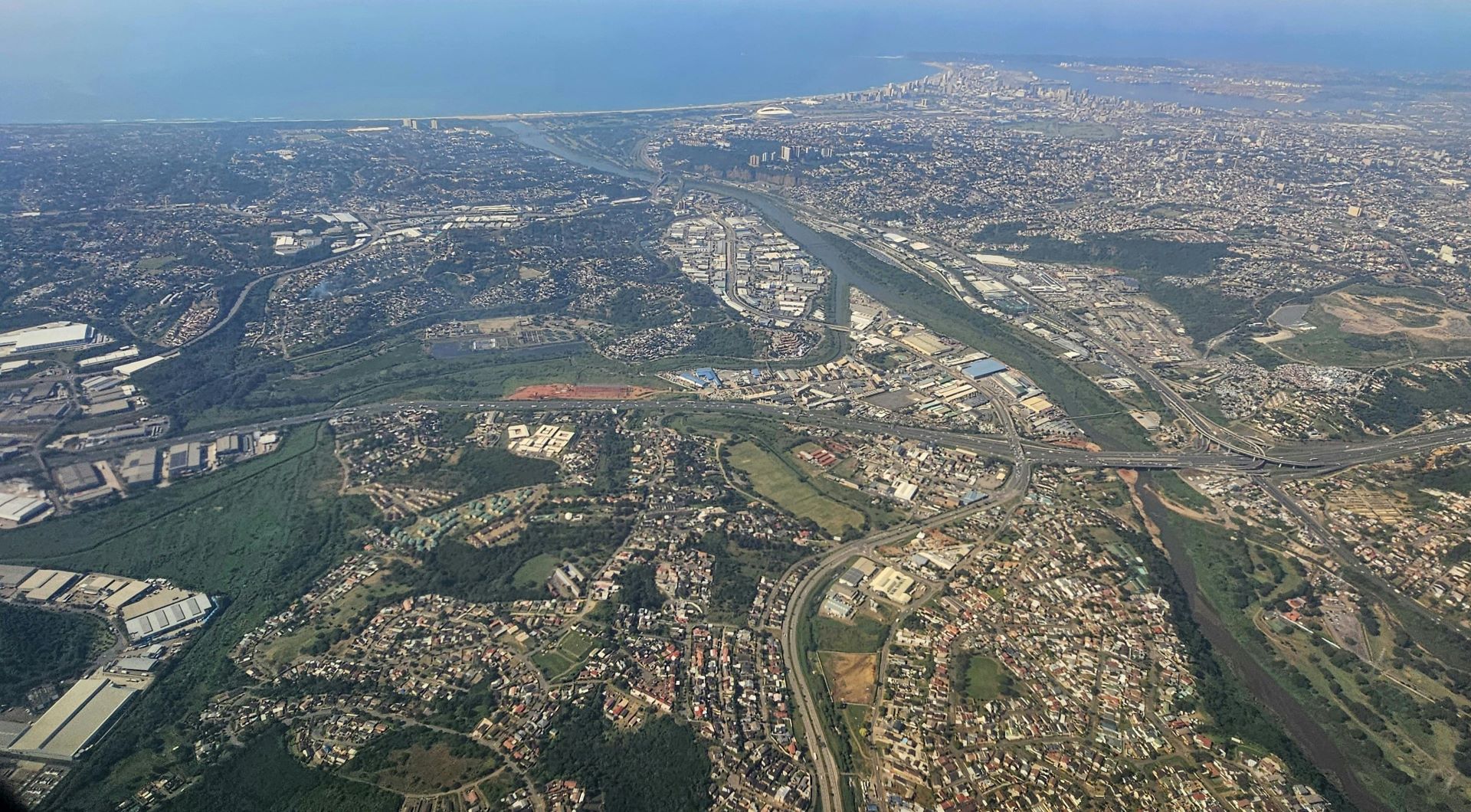
South Durban has long been the heavy engine room of eThekwini’s economy, where refineries, logistics corridors, port-linked manufacturing, and dense residential zones coexist in a tightly compressed urban system. Expansion here is not a distant policy concept. It is a daily physical force reshaping land use, transport networks, utilities, and building stock in real time.
Industrial growth in this region has historically been driven by proximity to the Port of Durban, one of the most important maritime gateways in southern Africa. As port capacity and logistics demand increase, surrounding industrial zones intensify in response, producing a ripple effect that extends far beyond factory gates into roads, drainage systems, housing, and municipal infrastructure corridors.
What makes South Durban unique is not only the scale of expansion, but its compression. Industrial plants sit close to residential suburbs, wetlands, and coastal ecosystems. This adjacency creates a constant negotiation between economic acceleration and environmental, infrastructural, and social thresholds.
Expansion as a structural load on the city
Industrial expansion is often celebrated in terms of job creation, investment inflows, and output growth. Yet every new logistics park, refinery upgrade, or transport corridor adds a parallel burden to the city’s structural systems.
In South Durban, this burden is felt most sharply in:
• Bulk water systems that must serve both industry and dense communities
• Road networks already saturated by freight traffic
• Sewer and drainage systems operating near or beyond designed capacity
• Electrical infrastructure increasingly strained by industrial demand peaks
The Southern Durban Basin, in particular, has already shown signs that environmental and infrastructural assimilation capacity is being exceeded under continuous development pressure.
Expansion does not simply “use” infrastructure. It reshapes its operating envelope. Systems designed for mid-century loads are now required to support 21st-century industrial intensity.
Port-driven growth and the logistics multiplier effect
The Port of Durban acts as the gravitational centre of industrial expansion in the region. As container throughput, vehicle handling capacity, and terminal upgrades increase, surrounding logistics infrastructure is forced into parallel evolution.
Major expansion plans aim to significantly increase container handling capacity over the coming decades, reinforcing Durban’s role as a global logistics node.
This creates a multiplier effect:
• More port capacity demands more road freight access
• More freight access accelerates warehousing and logistics parks
• More logistics parks intensify land conversion and soil sealing
• More sealed surfaces increase stormwater runoff and drainage strain
In South Durban, this chain reaction is particularly pronounced due to the limited availability of undeveloped land. Expansion therefore occurs through densification rather than outward sprawl, amplifying pressure on already stressed systems.
Soil, water, and the hidden geology of failure
One of the least visible consequences of rapid expansion is geotechnical instability. South Durban sits on a coastal plain where soil composition, groundwater movement, and reclaimed land conditions can vary significantly across short distances.
When industrial expansion accelerates without proportionate geotechnical reinforcement, several structural risks emerge:
• Differential settlement in large slab foundations
• Increased vulnerability of underground pipelines
• Accelerated corrosion in coastal industrial zones
• Drainage failure during high rainfall events
These are not dramatic, immediate failures. They are slow distortions of structural equilibrium. A warehouse floor that develops uneven loading. A pipeline that begins to sag under shifting soil. A stormwater system that drains correctly in design conditions but fails under compound rainfall and runoff loads.
Expansion in such an environment is less about construction and more about continuous structural negotiation with the ground itself.
Urban sprawl, industrial clustering, and infrastructure lag
eThekwini’s spatial development patterns have long been shaped by fragmented planning legacies, resulting in uneven densities and stretched infrastructure corridors. In South Durban, industrial clustering intensifies around key transport arteries, particularly those linked to the port.
This clustering creates efficiency in logistics but inefficiency in infrastructure servicing. Roads become freight-dominant corridors. Maintenance cycles shorten under heavy axle loads. Intersections become bottlenecks where commuter and industrial traffic collide.
At the same time, infrastructure expansion rarely keeps pace with industrial acceleration. The result is a persistent lag:
• Industry expands first
• Infrastructure reacts later
• Maintenance becomes corrective instead of preventive
This lag is where structural stress accumulates. Not in sudden collapse, but in chronic underperformance.
Maintenance under pressure: the invisible crisis
Building maintenance in South Durban is not simply a matter of upkeep schedules. It is a continuous response to accelerated wear cycles.
Industrial expansion increases maintenance demand in several ways:
• Higher vibration loads from freight movement affecting structures
• Increased exposure to chemical and atmospheric corrosion
• Faster degradation of road surfaces under heavy transport
• Greater strain on drainage and pumping infrastructure
In many cases, infrastructure is not failing because it was poorly built. It is failing because it is being asked to perform beyond its original design assumptions for extended periods.
This shifts maintenance from routine servicing to adaptive resilience engineering.
Coastal exposure and environmental compounding factors
South Durban’s coastal position introduces additional complexity. Salt-laden air accelerates corrosion of steel and reinforced concrete elements. High humidity intensifies material fatigue. Storm surges and extreme rainfall events introduce episodic stress spikes that test drainage and foundation resilience.
When combined with industrial expansion, these environmental forces create a compounding effect:
• Structural degradation accelerates faster than inland equivalents
• Maintenance intervals shorten
• Repair costs escalate over time
• System downtime becomes more frequent
The consequence is not just physical deterioration, but economic inefficiency embedded in infrastructure cycles.
Infrastructure as a living system under stress
A useful way to understand South Durban’s situation is to view infrastructure not as static assets, but as a living system with limits, adaptation mechanisms, and fatigue thresholds.
Under stable conditions, infrastructure operates within predictable stress ranges. Under rapid expansion, those ranges shift.
In South Durban, multiple stressors overlap:
• Industrial load expansion
• Port logistics intensification
• Residential density pressures
• Environmental exposure
• Aging legacy infrastructure
When these converge, the system begins to behave less like engineered infrastructure and more like a continuously adapting organism under chronic strain.
Structural consequences of outpaced expansion
The most significant consequences of rapid industrial expansion in South Durban are not isolated failures, but systemic distortions:
• Reduced infrastructure lifespan across multiple asset classes
• Increased maintenance backlogs and reactive repairs
• Higher long-term municipal expenditure on correction rather than prevention
• Growing mismatch between design standards and real-world loading conditions
• Elevated risk of localized structural failures during extreme events
These outcomes do not signal collapse. They signal misalignment between growth velocity and infrastructural resilience.
Toward a resilience-led expansion model
The challenge for South Durban is not to slow industrial growth, but to reframe it through resilience capacity rather than output capacity.
This requires a shift in how expansion is planned:
• Infrastructure upgrades must precede or match industrial approvals
• Geotechnical and environmental thresholds must guide zoning decisions
• Maintenance planning must be embedded in development economics
• Logistics expansion must integrate multimodal load distribution
• Drainage and water systems must be treated as critical economic infrastructure
In essence, expansion must stop being treated as a linear progression and instead be managed as a layered system of interdependent thresholds.
Growth that must learn its own limits
South Durban represents one of the clearest examples of industrial expansion operating at the edge of infrastructural endurance. The region’s economic importance is undeniable, but so too is the structural tension created by its pace of growth.
When expansion consistently outruns resilience, infrastructure begins to behave less like a foundation and more like a negotiator, constantly recalibrating under pressure.
The future of industrial growth in South Durban will depend not only on how fast it expands, but on how intelligently it learns to respect the structural limits of the ground beneath it.